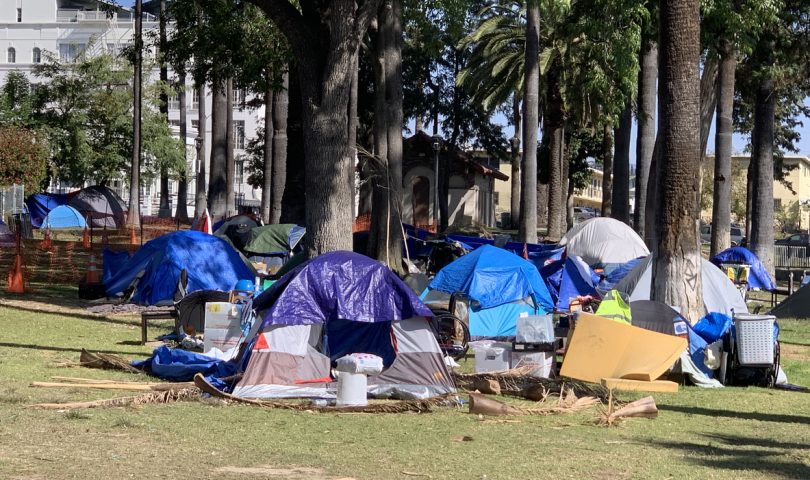
This essay contains excerpts from the forthcoming report, Equity for Whom? How Private Equity and the Punishment Bureaucracy Exploit Disabled People.
“Prisons and jails are the new asylums.” It is time to dispel this widespread fallacy maintained by politicians, journalists, mental health professionals, and even many criminal legal reformists. “Prisons and jails are the new asylums” is an oft-repeated but ahistorical claim that implicitly endorses the ableist belief that Disabled people are in need of correction and containment. A recent article in NBC News about a “model” mental health unit in a New Orleans jail, repeats the trope, which goes:
“Large mental institutions and psychiatric facilities closed down, many on account of reported mistreatment and abuse. Most American communities, both in rural and urban areas, failed to build enough modern clinics and hospitals to replace the old wards. As a result, the jails in cities like New Orleans, Los Angeles, Chicago and New York are among the largest mental health care providers in the nation.”
The first fallacy contained in the above statement is that deinstitutionalization resulted in a mass transfer of formerly institutionalized people to the streets, where many of them were subsequently rounded up into prisons and jails. But, as Liat Ben-Moshe (2020) and Shinn and Khadduri (2020) note in their groundbreaking works, Decarcerating Disability and In the Midst of Plenty: Homelessness and What to Do About It, respectively, deinstitutionalization preceded mass housing insecurity and mass incarceration by a few decades. Some formerly institutionalized people did end up in nursing homes, group homes, and single-room occupancy (SRO) housing, but not on the streets. Reagan-era policies of welfare retrenchment and the War on Drugs targeted a different generation of primarily young Black men to fill the void left after one carceral system (the asylum) closed down and another (prisons and jails) expanded. The mass incarceration and debilitation of poor people, Black people, and Disabled people, especially people at the intersections of these identities, is the deliberate result of racialized policies of criminalization and dismantling of social safety nets since the 1980s, which can be viewed as reactionary attempts to push back the gains made by marginalized groups during the civil rights era.
It’s a specious argument: Disabled people belong in institutions, because there are many Disabled people who are incarcerated. But the people making this argument often neglect to mention that it’s our policies that have deliberately and actively put Disabled people in these carceral spaces.
“Jails… are among the largest mental health care providers in the nation.” The second fallacy, that prisons and jails could ever be places of real care and healing, is not borne out by the countless deaths, murders, trauma, and cases of abuse and neglect that occur within these facilities. This is in addition to the irreparable harm, stigma, and discrimination that come with being labeled as a criminal or formerly incarcerated person, and the impacts on future employment, education, housing, and other opportunities, such as qualifying for welfare benefits including food stamps and subsidized housing. For Disabled people especially, because prisons and jails are designed to be punitive as opposed to restorative spaces, and because correctional staff are not trained to recognize or accommodate “human variation,” the overall negative impacts of being incarcerated far outweigh any positives that may result from the care offered inside these facilities. The widespread use of seclusion, force, and restraint in carceral settings, for example, is highly antagonistic to many Disabled people. Last year, an autistic teen, Isaiah Trammell, died after being held in a cell at the Montgomery County Jail in Ohio for ten hours, where he repeatedly banged his head on the walls while guards taunted him.
Countless news stories indicate that these are not isolated incidents, and recent studies have shown that incarceration by itself results in disablement, debilitation, and poor mental health outcomes. As Ben-Moshe argues, “Discussing [prisons and jails] as places in which people can or do get treatment is not only inaccurate but also ethically and ideologically problematic, as it legitimizes incarceration and makes it appear needed and normalized.”
“Failed to build enough modern clinics and hospitals to replace the old wards.” The last fallacy is the belief that something must replace the asylum. It’s often implied that by “failing” to replace the asylum, Disabled people will inevitably end up on the streets or in jails, because they presumably need to be in institutional care or in “treatment.” While the impacts of disinvestment in community-based services cannot be understated, a singular focus on the lack of mental health services can be as misleading as other critiques of deinstitutionalization, particularly in its purported relations to crime and houselessness, in that it overly medicalizes, and hence obscures, the racialized projects of community divestment and criminalization, not to mention that it perpetuates a long and ableist history of pathologizing Disabled individuals via expectations of compliance with cisheteronormative behavior. Critics of deinstitutionalization take a too narrow and individual-focused perspective by failing to consider how lack of human, social, and financial capital increase the risk of entanglement with the criminal legal system, and how racism, poverty, criminalization, policing, surveillance, and confinement are inherently debilitating and (re)traumatizing. No amount of mental health care alone can undo these feeders of mass incarceration, but even if we accept the proposition that there is a subset of unhoused people with “severe and persistent mental illness” who need behavioral case management in order to prevent them from “drifting onto the streets,” we must recognize the fact that it is the lack of affordable housing that has created mass houselessness across the country, and that in turn is overtaxing municipalities’ resources in such a way that the most vulnerable people are being neglected and criminalized.
Those criminal legal reform advocates who respond to the disproportionate number of Disabled people in prisons and jails by arguing that we need more psychiatric hospitals or mental health courts, forget that institutionalization and coercive treatment are inherently carceral tools of silencing, coercion, and erasure, and that Black men were institutionalized in the 1960s because they fought for civil rights, and people, often women and children, have been and continue to be institutionalized when they report being sexually assaulted. Resistance to oppression is often pathologized as mental illness, and victimized people and people with grievances are hence perceived as threats. Those who argue for a return to institutionalization also forget that “those hospitals had deteriorated to conditions shockingly similar to today’s worst correctional facilities.” In this context, it’s curious but perhaps not surprising that NBC News’ glowing article on the New Orleans jail fails to mention that the jail is contracted with Wellpath, a private equity-owned correctional healthcare company with a long history of lawsuits, wrongful deaths, and complaints of shoddy care. Nor did the article capture the bigger story, which is that the jail had exceeded its maximum capacity this year, representing a troubling 80 percent increase in its population since 2021. No amount of internal reform can fix the individual and societal damage that results from incarcerating more people in jails. And, if the growing number of “diversion” programs in this country is not concurrently reducing the number of people incarcerated in prisons, jails, and detention centers, then these programs must reasonably be considered an expansion of the carceral state.
For forty years, politicians have repeatedly victim-blamed, scapegoated, and criminalized unhoused people, but the problem of mass housing insecurity remains entrenched in large cities across the country, mainly because politicians refuse to tackle its root problems—unaffordable housing and rampant income inequality. While it’s important to recognize that houselessness is a housing problem, however, we must also be wary of homeless advocates whose main argument boils down to “Not all homeless people are mentally ill.” In our advocacy efforts, it is important that we not marginalize and stigmatize one vulnerable group for another. It is important not to invisibilize, pathologize, or victim blame the significant subset of unhoused people who are disabled or experiencing mental illness, which can be a lifelong identity or impermanent response to precarity and living on the margins of society. As the historian and disability scholar, Douglas C. Baynton, has argued, “This common strategy for attaining equal rights, which seeks to distance one’s own group from imputations of disability and therefore tacitly accepts the idea that disability is a legitimate reason for inequality, is perhaps one of the factors responsible for making discrimination against people with disabilities so persistent and the struggle for disability rights so difficult.”