
In October, 1948, Tim Nugent, a 24-year-old disabled WWII veteran and graduate student in education psychology at University of Wisconsin, established the Disability Resources and Educational Services (DRES) program at the University of Illinois. The program was housed at Galesburg, a newly constructed, accessible campus with only single-story buildings connected by wheelchair-friendly corridors. While there were three other campuses in the country that could accommodate physically disabled students at the time, the University of Illinois had “the only complete program in the nation of corrective therapy and rehabilitation” for wheelchair users.
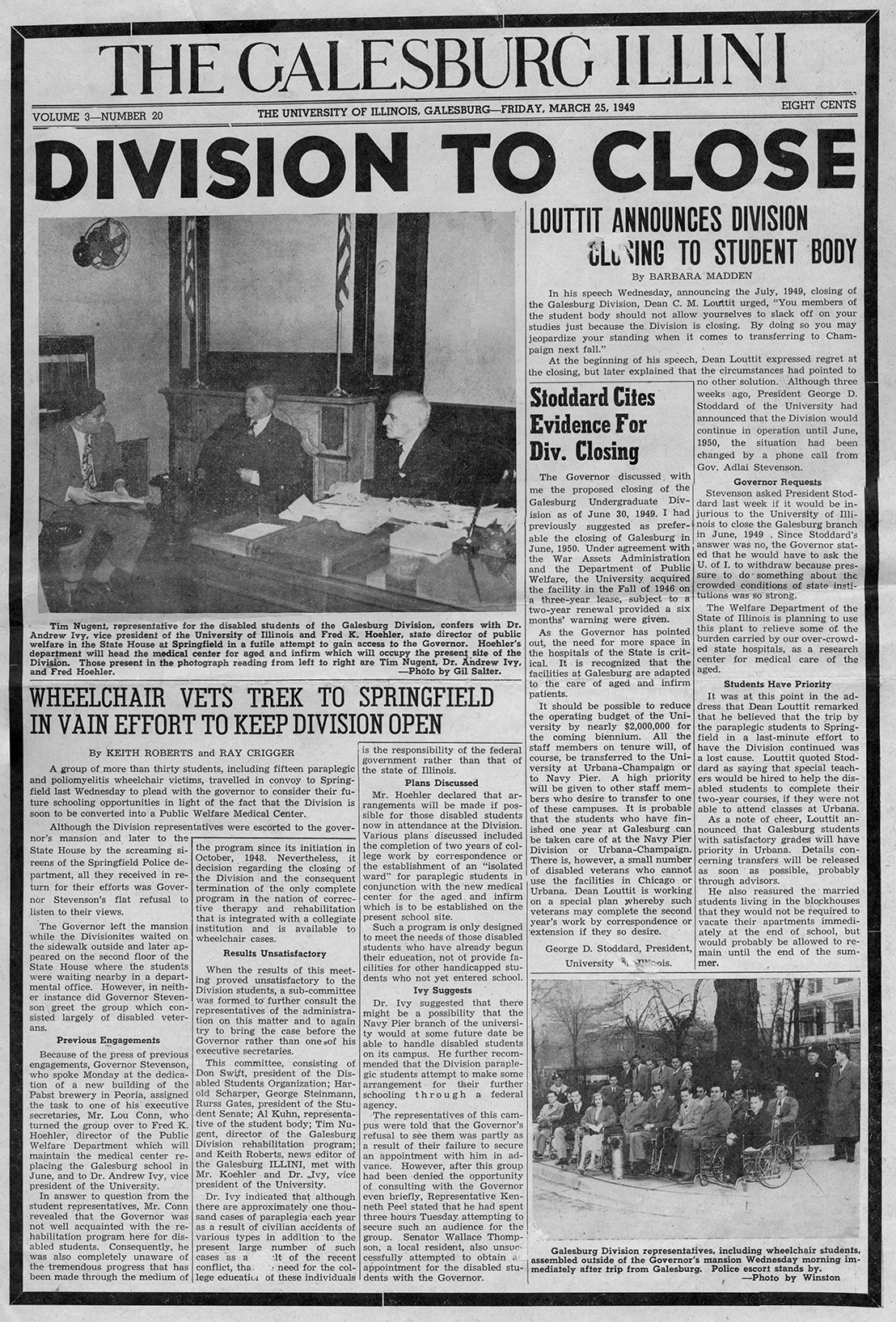
Thirteen disabled students enrolled full-time at Galesburg in the fall of 1948, while one additional student had started earlier, in the spring semester. Nugent and his students accomplished an impressive amount in that first year, establishing both the Delta Sigma Omicron Rehabilitation Service Fraternity for students with disabilities, and the first National Wheelchair Basketball Tournament. Unfortunately, the governor of Illinois announced that he would be closing the program in order to convert the Galesburg campus into a medical center to relieve some of the overcrowding at the state-run institutions. Some of the current Galesburg students were allowed to apply for transfer admission to the University of Illinois at Urbana-Champaign, but there were no plans to admit more students to the program.
A year later, with pledged support from the Veterans Administration, Nugent convinced the University of Illinois to allow the DRES program to continue on the Champaign-Urbana (UIUC) campus, though without university funding. On May 4, 1949, the fourteen Galesburg students were notified that they were officially admitted to UIUC. The incoming students represented diverse backgrounds. One student was 49 years old. Many were disabled veterans. Some students had only recently become disabled while others had been hidden inside their homes or in nursing homes for most of their lives.
Although it’s hard to appreciate today, what Nugent was building at the time was “a revolutionary idea.” Despite the country’s renewed awareness of disability issues as a result of the hundreds of thousands of disabled veterans returning from the war, as well as the increasing population of newly disabled civilians from ongoing polio outbreaks across the country, the prevailing belief was still that disabled people belonged in nursing homes, not on college campuses. Many believed that a college education would be wasted on people who “would forever be relegated to a position on a porch, watching life go by.”
Nugent would describe the early years of the program as an uphill battle “with little support, and often outright opposition.” For the first few years, the university refused to fund or publicize the program, concerned that UIUC would develop a reputation as the “paraplegic university.” Faculty complained that disabled students on campus were “distracting, demoralizing [and would] present untold difficulties, and probably not put their college education to good use.” Animosity was directed towards the students as well, mainly from the parents of nondisabled students at UI. One parent reportedly told one of the DRES students, “We should be protected against your dating or socializing with our sons and daughters.”
In 1951, Greyhound donated two buses to DRES, and Nugent worked with his friends at the Blitz Corporation to equip the buses with hydraulic lifts, creating the first accessible university transit system in the country. Within a few years, many of the main classroom buildings had ramps, and curb cuts had been installed on the main pathways around campus. “No other university campus even contemplated this kind of innovation at this early date,” noted the late disability scholar, Steven E. Brown. As a result of the changes Nugent made to the campus’ infrastructure, UIUC became the premier accessible campus in the country.
The program’s reputation was growing nationally, and in 1955, the University of Illinois Senate passed a resolution to fund DRES, making it an official division within the university. The prior year, 170 disabled people across the country applied for admission to DRES, and Nugent had to start turning students away as he could only take 120.
Given the overwhelmingly negative societal attitudes at the time that framed disabled people as a burden on society, Nugent felt strongly that the only way to change those attitudes was by having the DRES students prove to the world that they could be independent and would become “contributors to society.” He consequently admitted to the program only the most physically capable disabled students who would represent the program well. If society believed that disabled people were too dependent, then instead of challenging society’s negative and ableist ideas about dependence (and interdependence), Nugent wanted his disabled students to disprove nondisabled people’s stereotypes about disability, to conform to able-bodied norms and expectations.
In addition to having to get past the university’s general admissions process, disabled applicants to UIUC had to survive “functional training week” (known as “Hell Week” to DRES students), which was overseen by The Rehabilitation Center. In the span of a week, students had to prove to Nugent that they were physically independent—that they could get themselves in and out of bed, shower, dress themselves, and use the toilet without any assistance. Students risked expulsion if they allowed anyone to push their wheelchairs or assist with activities of daily living. Nugent adamantly refused to allow students to use motorized wheelchairs, although this restriction was loosened by the late ‘60s as power wheelchairs became more widespread. Prior to that, students in manual wheelchairs often had to push themselves to the point of exertion across UIUC’s sprawling campus, often necessitating hourlong treks just to get to their classes.
For Nugent, if independence meant “overcoming” one’s disability, then visibility meant using every opportunity to demonstrate his students’ independence to the world. This was partly why Nugent started the adaptive sports program at UIUC, where he founded the first university wheelchair basketball team in the country, and helped to establish the National Wheelchair Basketball Association in the same year. Going on tour with the team was considered one of the highest privileges for the students, but the adaptive sports teams also raised lots of money for the university. “Observing wheelchair-using athletes participating in sports indicated to the general public both their level of passion to remain involved in life’s activities and their dedication to the pursuit of goals. It also served as an excellent public relations tool,” noted Brown.
Disabled students at UIUC were therefore constantly being tasked to perform, both for Nugent’s permission to stay in the program and for society’s approval. The motto of the Delta Sigma Omicron fraternity summarized this obligation: “To exercise our abilities to a maximum so as to minimize our disabilities, that we may live most and serve best.” It was a sink or swim environment for the students.
Fred Fay was one of the students in the early years of the DRES program. A future disability rights leader and founder of the Boston Center for Independent Living, Fay recounted a classmate’s experience during Hell Week that reveals the extremes to which students were demanded to perform their independence:
“The first thing I remember was a classmate who was in bed, a quadriplegic, a little bit higher level than I. He had to get into his wheelchair to go down to eat breakfast, and he didn’t make it by breakfast. He just kept trying to get in the chair. Got to be lunch. He missed lunch. Got to be dinner. He missed dinner. Still trying to get in the chair. He finally managed by the end of the day to get in the chair, with a little help from the physical therapist, and ate breakfast and went back to bed. But I remember vividly his swearing an incredible stream of profanity, that he really didn’t need to go through all this torture.”
According to Fay, these types of experiences were not unusual.
Although many DRES students would graduate to fulfilling careers as medical doctors, attorneys, engineers, elected officials, and community leaders (including the future disability rights leaders, Mary Lou Breslin, Fred Fay, and Kitty Cone), there was also a high rate of attrition in the program. Some students burned out, while others were expelled for the slightest infractions. There was a tremendous pressure placed on the students to demonstrate that the inaccessibility of the campus was their problem to overcome. The message it sent was that disabled people needed to accommodate society and its negative attitudes, rather than challenging society’s negative attitudes about disability.
Halfway across the country, meanwhile, a vastly different model of disability inclusion was developing.
In 1962, the same year that Kitty Cone enrolled at UIUC, Ed Roberts, the “father of the disability rights movement,” was starting at the University of California at Berkeley.
One may reasonably ask why Roberts didn’t go to UIUC, if the University of Illinois at Urbana-Champaign was the premier campus for disabled students at the time. The reality is that he probably wouldn’t have been accepted as he would have been considered “too dependent.” He used a motorized wheelchair. He needed personal attendants to help with activities of daily living. He slept in an iron lung to help with his breathing.
While Roberts would not have been welcome at UIUC, the administrators at Berkeley were not exactly embracing him with open arms either. “We’ve tried cripples before and it didn’t work,” said one dean.
The prestigious Berkeley campus was not yet the accessibility hub that it would become within a decade, and Roberts’ presence on campus flummoxed the administrators. He would need to be carried over the campus’ steps in order to get to classes. Instead of living in the dorms, Roberts would need to sleep on the third floor of Cowell Hospital, which was the only place on campus that could house his eight-hundred-pound iron lung.

While Ted Nugent ruled the DRES program at UIUC with an iron fist, the head of the program at Cowell, Dr. Henry Bruyn, was largely supportive of the students’ autonomy and the ways they chose to confront the hostile systems and architecture around campus. While the DRES program was very much Nugent’s brainchild, the Cowell residence at Berkeley developed more organically after Ed Roberts’ arrival. Roberts blazed a path when he matriculated at Berkeley, and as news spread across the country about the “helpless cripple” who enrolled at university, other physically disabled students soon followed.
By the time Roberts started working on his graduate degree at Berkeley in the late 1960s, there were a dozen disabled students residing with him at Cowell. The students were allowed to have personal attendants, and those attendants, many of whom were gay, became staunch allies in the disabled students’ struggles for autonomy, as they saw parallels to their own struggles for equality. While UIUC was certainly not insulated from the anti-Vietnam War protests and the civil rights activism spreading across the country (indeed, Kitty Cone had been arrested a few times on campus for organizing protests), Berkeley was at the center of the Free Speech Movement. The environment at Berkeley was thus conducive to a critical analysis of disability.
The historian, Fred Pelka, says that, in retrospect, Nugent can be viewed “as a bridge between the paternalism of the vocational rehabilitation movement of the 1940s and ’50s and the modern era of disability rights.” After the end of the second World War in the mid-20th century, the country was only beginning to reckon with the horrors of eugenics, born in the United States and taken to its logical extremes in Nazi Germany. Thus, the prevailing attitudes at the time in which Nugent established the DRES program were still in favor of denying disabled people their humanity and their right to exist in the community, let alone to pursue higher education. Despite Nugent’s best intentions, many of these recalcitrant societal prejudices against disability—as well as the predominant post-war beliefs in American exceptionalism, individualism, and meritocracy—would indelibly shape the way that the DRES program developed.
However, it’s also a bit of an exaggeration to claim, as Joseph Shapiro does, that “the disability rights movement was born the day Roberts arrived on the Berkeley campus.” The truth is that for the better part of a decade, the disabled students at Berkeley chugged along quietly and unremarkably, the third floor of Cowell developing a reputation as more of a frat house than a disability think tank.
It wasn’t until 1969 that the students’ late-night chats and idealism quickly coalesced into radical action, after the California Department of Rehabilitation took over the program at Cowell and assigned their own version of Nurse Ratched, a counselor named Lucile Withington, to instill order and discipline onto the rowdy group of “Rolling Quads.” When Withington attempted to kick two students out of the program, Roberts organized the Quads and mobilized the local media, utilizing every tactic he had learned from the civil rights demonstrations taking place around campus. Other campus organizations at Berkeley rallied around the disabled students. The administration backed down within weeks, removing Withington and reinstating the two students who had been expelled.
Whereas the Berkeley students would go on to establish their own Disabled Students’ Program and the Center for Independent Living in Berkeley, which would become a major force in pushing forward the most important legislative victories in disability rights history, Nugent’s beliefs about change could best be described as “educate, not legislate.” Nugent believed that by conforming to nondisabled society’s expectations, nondisabled people would begin to open doors for disabled people. He did not believe that true attitude change and true inclusion could be legislated. While there is some truth to this, it’s complicated by the fact that the DRES program itself excluded many less privileged disabled students, people who, like Ed Roberts, absolutely would not have been able to muscle or charm their way into mainstream society. For many disabled people, it was Section 504 of the Rehabilitation Act, implemented in 1977, and the Americans with Disabilities Act (ADA), signed into law in 1990, that opened doors.
UIUC and Berkeley developed extremely divergent models of independence. At UIUC, independence meant rejecting others’ help and striving to approximate able-bodiedness as much as possible. There was high attrition in the program, and students were largely powerless to intervene when Nugent forced out their peers or when they were confronted with other injustices. In contrast, at Berkeley, independence was inextricable from interdependence and community. The students protested when their peers were threatened with expulsion, and they learned that as individuals they were vulnerable, but as a collective they had power. The students at Berkeley realized that their struggles were part of a larger civil rights movement, that they could question a broken system, and that they could fight back to make the world a better place.
Although Nugent’s paternalistic and rigid attitudes about disability and independence would be considered toxic and ableist today, his legacy is undeniable. Future disability rights leaders, including Mary Lou Breslin, Fred Fay, and Kitty Cone, were brought together and graduated from UIUC, an opportunity made possible only because of Nugent’s singular vision and determination. The adaptive sports program at UIUC, which Nugent founded, would go on to produce hundreds of world-class athletes, including Susan Hagel, Jean Driscoll, and Tatyana McFadden. U.S. senators and federal appointees have graduated from the DRES program.
Tom Linde, who graduated with a Ph.D. in psychology from UIUC after being told by Nugent that he “could not hack it in graduate school at Champaign-Urbana,” perhaps summarizes Nugent’s legacy best: “There is a general tendency these days to look with disfavor upon the way Professor Nugent initiated us into the world he had, single-handedly, created at the University of Illinois. Given the spirit of the time in which he was working, he had no valid alternative.”
For further reading:
An Independent Man: Ed Roberts and the Fight for Disability Rights, by Scot Danforth
“Breaking Barriers: The Pioneering Disability Students Services Program at the University of Illinois, 1948–1960,” by Steven E. Brown, In: The History of Discrimination in U.S. Education, by Eileen H. Tamura (editor)
Expanding Horizons: The Illustrated History of DRES, by University of Illinois
No Pity: People with Disabilities Forging a New Civil Rights Movement, by Joseph P. Shapiro
What We Have Done: An Oral History of the Disability Rights Movement, by Fred Pelka